



Ottoman power struggles reflected in dreams: Molla Gurani and Selim I
Historical records reveal how Ottoman succession battles and palace intrigues, involving figures like Molla Gurani, were directly reflected in symbolic dreams.


DREAMS WISDOM / NEW YORK, USA
Historical records indicate that the periods of crisis and power struggles within the Ottoman Empire were directly reflected in the dreams of prominent figures, serving as a symbolic mirror to the state's political climate.
According to historical research, some of the earliest recorded dreams linked to political events belong to Molla Gurani, the tutor of Mehmed the Conqueror and a former Shaykh al-Islam. Molla Gurani’s dreams are analyzed not merely as personal spiritual experiences but as symbolic expressions of palace intrigues, the Cem Sultan issue, and his own ideological disagreements with the Sultan.
Molla Gurani’s "Ruined House" dream and its symbolism
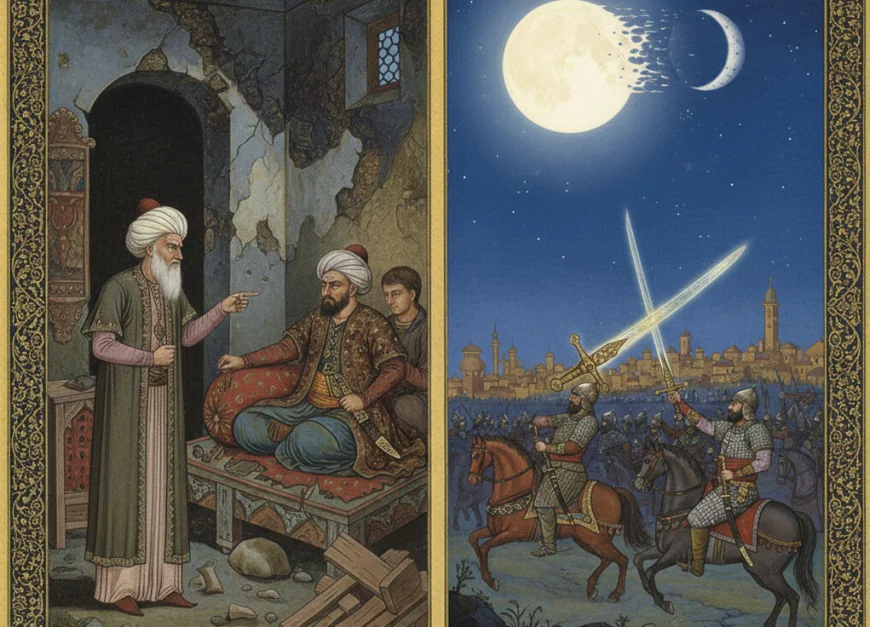
Molla Gurani described a dream during a period of intense palace tension where he was invited by the Sultan to a ruined house. In this dream, the Sultan sat in a dark room with a shaved beard, wearing an Armenian belt, and shouted at Gurani in a manner he could not understand. Historians interpret this as a reflection of the friction caused when Gurani famously rejected a proposal from the Sultan on the grounds that it contradicted religious law, leading to his temporary removal from office and departure to the Hijaz.


Following this, Gurani cited another dream involving two moons in Karaman—one full and one a crescent—where the crescent moon vanished. He used this to reassure the administration that the "incomplete" or troubled situation of the state would soon pass, emphasizing that the dreams of the righteous do not contradict each other and serve as "mujde" (glad tidings).
Power struggles during the reign of Selim I
The reflection of political conflict in dreams continued during the reign of Yavuz Sultan Selim (Selim I) and his struggle against his brother, Prince Ahmed. A dervish named Pir Nazar Halife recorded a dream on May 3, 1512, where he saw Prince Ahmed and his soldiers with only half of their faces visible. In the dream, the dervish scolded the Prince for dividing the Muslim community, a vision that preceded the Prince’s eventual defeat.
Another notable dream from this era was recounted by Defterdar Kasım Bey. He described a vision where Sultan Alaaddin (Ahmed's son) held a knife that, no matter who tried to take it, would always jump back into the hands of Sultan Selim. This was interpreted as a sign of the legitimacy and permanence of Selim I's authority during the civil war.
Political fiction versus subconscious reality
While modern historians consider that some of these dreams might have been "constructed" by individuals seeking favors (atiyye) from the Sultan, the case of Molla Gurani stands apart. Given his reputation for uncompromising integrity and his history of standing up to the Sultan, his dreams are viewed as genuine subconscious reflections of the heavy political atmosphere. These records prove that in the Ottoman world, dreams functioned not only as spiritual guides but also as critical tools for political communication and legitimacy.


What's Your Reaction?
 Like
0
Like
0
 Dislike
0
Dislike
0
 Love
0
Love
0
 Funny
0
Funny
0
 Wow
0
Wow
0
 Sad
0
Sad
0
 Angry
0
Angry
0

Editorial Desk |DreamWisdom.com is a comprehensive knowledge and editorial platform focused on dreams, dream interpretation, and dream science. The platform explores religious, psychological, cultural, and scientific perspectives, bringing together classical dream traditions with modern analytical approaches.



















Comments (0)