



Venus, Jupiter, Astrology, Skywatching, Astronomy, Planetary Conjunction
Venus and Jupiter appeared close together after sunset on June 8-9, creating a bright western-sky conjunction visible to many skywatchers.


By Bilge Türk | Dreams Wisdom
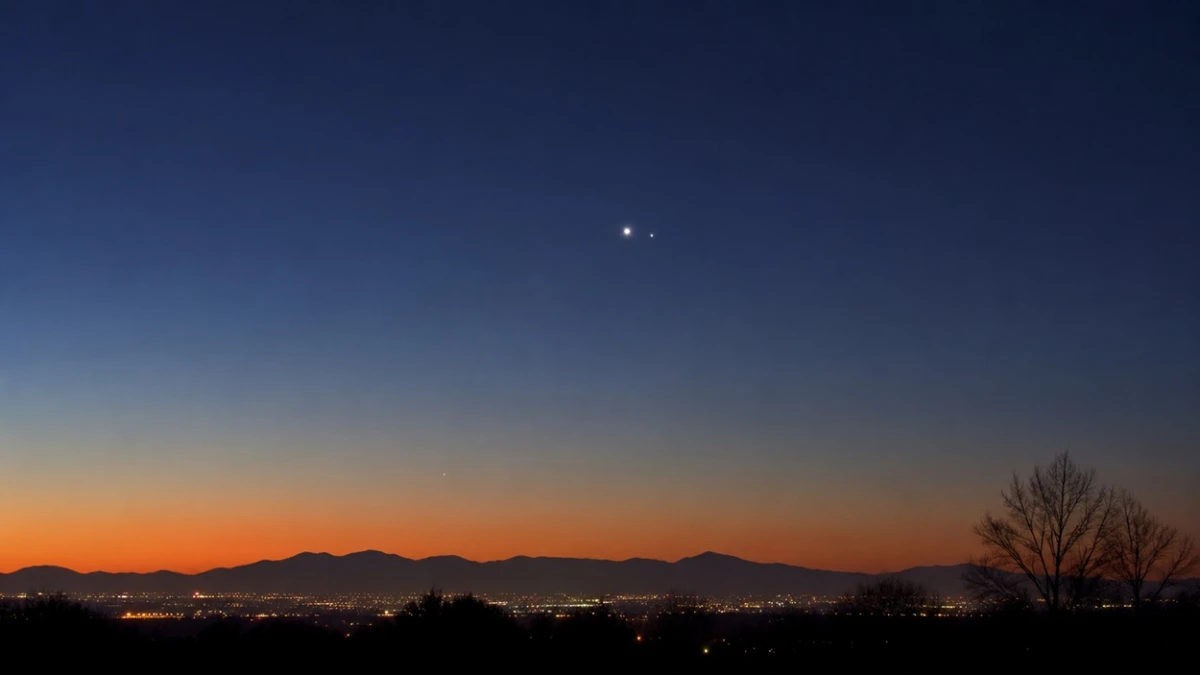
NEW YORK, UNITED STATES — Venus and Jupiter appeared close together in the western sky after sunset on June 8-9, offering one of June’s most eye-catching planetary views.
The bright pairing drew attention from skywatchers and astrology followers alike, especially after social media posts described the event as a rare “meeting” of the two brightest planets. Astronomers describe the scene as a planetary conjunction, meaning Venus and Jupiter appeared close together from Earth’s point of view even though they remained separated by vast distances in space.
The closest view came on June 8-9
According to NASA’s June 2026 skywatching guidance, Venus and Jupiter formed a visible conjunction around June 9, with both planets appearing in the western sky after sunset. Other astronomy outlets also noted that the best viewing window was around June 8-9, when the two bright planets looked especially close in evening twilight.


This timing is important because the event was not a long-lasting alignment at the same intensity. The planets remained visible near each other for several evenings, but the most striking view came during the peak period. Observers who missed the closest approach could still see Venus and Jupiter in the same region of the sky for a short time afterward, although the apparent distance between them gradually changed.
Where skywatchers had to look
The best direction for viewing was the western or west-northwestern horizon shortly after sunset. NASA’s sky chart for June 9 placed Venus and Jupiter low in the evening sky, making a clear horizon especially important.
For many observers, the ideal viewing time was roughly 30 to 90 minutes after sunset. Too early, the sky was still bright enough to make the planets harder to see. Too late, the pair moved lower toward the horizon and became more difficult to observe. Buildings, trees, mountains and city haze could block the view, particularly because the planets were not high overhead.
Why Venus and Jupiter looked so bright
Venus and Jupiter are often described as the two brightest planets visible from Earth. Venus appears brilliant because it is relatively close to Earth and covered by reflective clouds that bounce sunlight strongly. Jupiter is much farther away, but it is enormous, making it a prominent object in the night sky.


During the June conjunction, the two planets did not physically approach each other in space. Their apparent closeness was caused by perspective. From Earth, their positions lined up in the same region of the sky, creating the visual impression of a close pairing. This is why a conjunction can look dramatic from the ground while the planets remain hundreds of millions of miles apart.
Mercury added another challenge
Several skywatching guides noted that Mercury joined the evening display shortly after the Venus-Jupiter conjunction period. NASA listed June 11-15 as the window when Mercury could be seen near Venus and Jupiter after sunset.
Mercury is harder to observe than Venus or Jupiter because it stays close to the Sun from Earth’s perspective. That means it usually appears low in twilight, where the sky is brighter and the viewing window is shorter. Observers needed a very clear western horizon and good timing to catch it. Binoculars could help, but viewers were advised never to look toward the Sun with optical equipment before the Sun had fully set.
The Gemini connection
Some skywatching descriptions placed the conjunction near the Gemini region of the sky, close to the bright stars Castor and Pollux. These two stars are often identified as the “heads” of the Gemini twins and can help observers recognize the constellation when the sky is dark enough.
However, during twilight, planets are usually easier to spot than stars. Venus and Jupiter shone like two bright lamps, while nearby stars could be harder to see until the sky darkened. For beginners, the simplest method was to find an open western horizon after sunset and look for the two brightest points in that part of the sky.
Astronomy and astrology are different lenses
The social media post that popularized the event used both astronomy and astrology hashtags. Scientifically, the Venus-Jupiter conjunction is explained by orbital motion and line-of-sight geometry. Astronomers can calculate such events in advance because planetary positions follow predictable paths around the Sun.
Astrology approaches the same sky event differently. In astrological traditions, Venus is often associated with love, beauty, harmony and pleasure, while Jupiter is commonly linked with growth, fortune, expansion and wisdom. For that reason, many astrology followers interpret a Venus-Jupiter conjunction as a symbolic period of optimism, generosity or emotional opening.
These meanings are symbolic interpretations, not scientific measurements. The astronomical event can be observed, photographed and calculated; the astrological reading belongs to a separate interpretive tradition. For many people, the appeal of such moments comes from experiencing both dimensions: the visible beauty of the sky and the cultural meanings humans have attached to it for centuries.
How to photograph the conjunction
The Venus-Jupiter conjunction was bright enough to be photographed with many modern smartphones. The best results usually came from using a stable surface or tripod, turning off excessive digital zoom and including a foreground element such as a skyline, tree line, hill or building.
Night mode or longer exposure settings could help capture the twilight sky, but too much exposure could wash out the planets. A wide-angle composition often worked better than trying to zoom in on the planets, especially for phone cameras. The most visually pleasing images typically showed the planets in context, with the horizon giving scale to the scene.
Why these events attract public attention
Planetary conjunctions are among the easiest sky events for the public to enjoy because they usually do not require a telescope. Unlike faint comets or deep-sky objects, Venus and Jupiter can be seen even from many urban areas if the horizon is clear and the weather cooperates.
Events like this also offer a simple entry point into astronomy. A person who notices two bright “stars” near the horizon may learn that they are planets, discover how they move from night to night and begin to understand how Earth’s own position shapes what we see in the sky. In that sense, a brief evening view can open the door to a wider curiosity about the solar system.
A brief but memorable sky scene
The June 2026 Venus-Jupiter conjunction was not a physical collision, a supernatural event or a once-in-a-lifetime disappearance of the planets. It was a predictable but beautiful alignment in Earth’s sky, made special by the brightness of both planets and their low position in the evening twilight.
For observers who saw it, the scene offered a reminder of how much can be noticed with the naked eye. A few minutes after sunset, with a clear view toward the west, the sky placed two of its brightest planets side by side and turned an ordinary evening into a shared celestial moment.
What's Your Reaction?
 Like
0
Like
0
 Dislike
0
Dislike
0
 Love
0
Love
0
 Funny
0
Funny
0
 Wow
0
Wow
0
 Sad
0
Sad
0
 Angry
0
Angry
0

Editorial Desk |DreamWisdom.com is a comprehensive knowledge and editorial platform focused on dreams, dream interpretation, and dream science. The platform explores religious, psychological, cultural, and scientific perspectives, bringing together classical dream traditions with modern analytical approaches.





















Comments (0)